Automotive manufacturing has changed significantly over the years.
What once depended heavily on manual processes has gradually evolved into an industry that uses robotics, automated production lines, digital monitoring and advanced engineering technologies.
Today, another important change is taking place.
Factories are moving beyond automation towards systems that can collect information, identify patterns and help people make better decisions.
This transformation is commonly known as Industry 4.0, or the Fourth Industrial Revolution.
But what does Industry 4.0 actually mean, and how does it affect everyday manufacturing?
What is Industry 4.0?
Industry 4.0 refers to the use of connected machines, digital technologies, automation and data analysis to improve industrial operations.
In traditional manufacturing, machines often perform specific tasks independently.
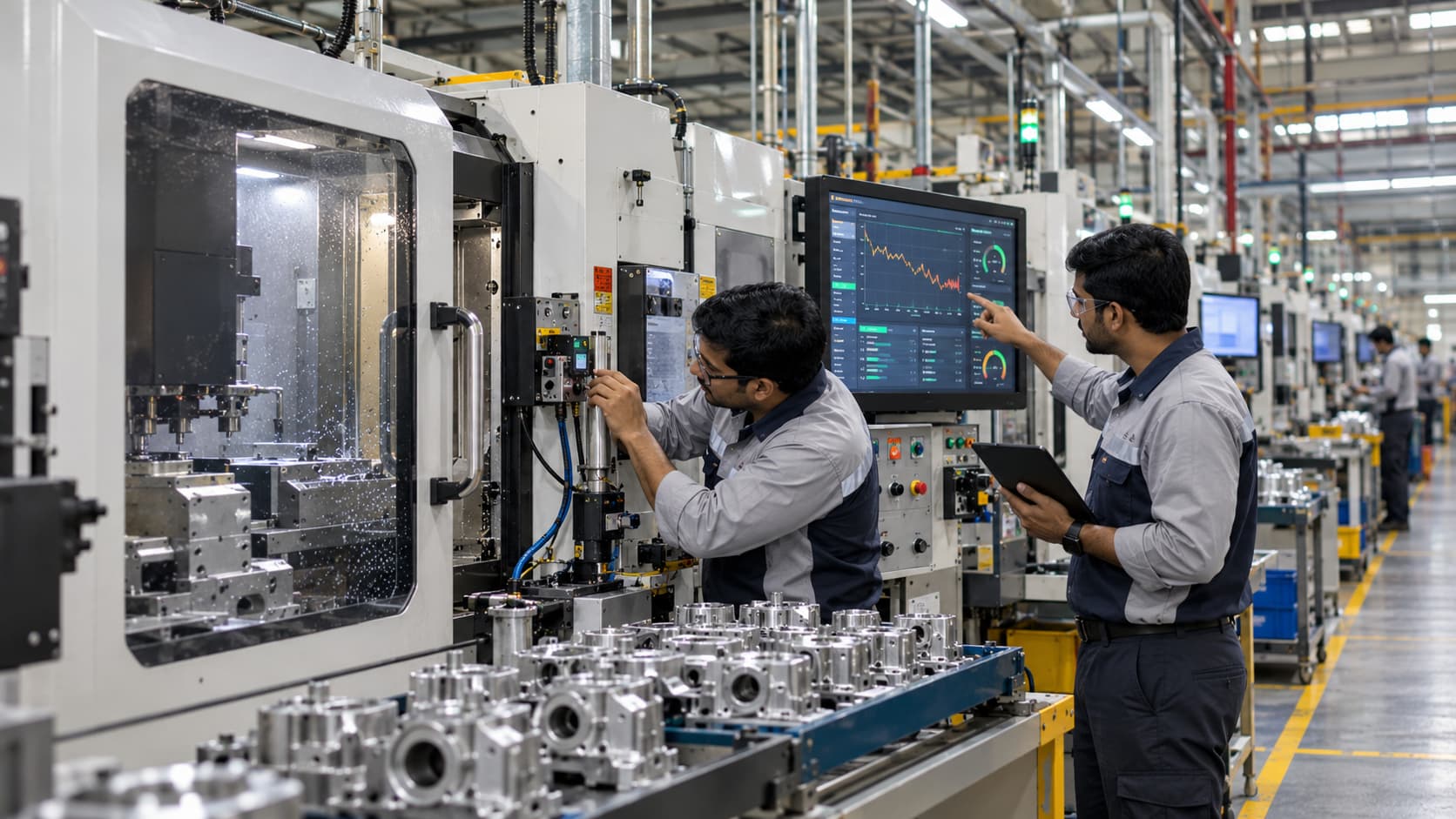
In an Industry 4.0 environment, machines and systems can exchange information, allowing production teams to monitor processes and make decisions using real-time data.
For example, a production line may have several machines performing different operations.
If one machine begins operating outside its expected parameters, a connected monitoring system can alert the production team before the issue affects the next stage.
The objective is not simply to automate more tasks. It is to make the entire manufacturing process more efficient, reliable and transparent.
-
Smart factories: Connecting machines and information
A smart factory uses digital systems to connect equipment, processes and people.
Sensors installed on manufacturing equipment can collect information about temperature, pressure, machine speed, production output and other operating conditions.
This information can then be analysed to understand how different parts of the factory are performing.
Consider an automotive component manufacturing facility producing thousands of parts every day.
If a machine starts operating more slowly than usual, a connected system can help identify the change.
Production teams can investigate the issue before it causes significant delays.
Over time, this information can also help manufacturers improve production planning and equipment utilisation.
-
Artificial intelligence in manufacturing
Artificial intelligence is becoming increasingly useful in manufacturing because it can help analyse large amounts of information.
One application is quality inspection.
Traditional quality checks often depend on manual inspection or predefined measurement systems.
AI-supported visual inspection systems can analyse images of manufactured components and identify possible defects or irregularities.
For example, a camera-based inspection system may help detect surface defects, dimensional variations or missing components, depending on how the system has been designed and trained.
AI can also support production planning, equipment monitoring and maintenance decisions.
However, these systems still require proper validation and human supervision, particularly when product quality and safety are involved.
-
Predictive maintenance: Reducing unexpected downtime
Equipment breakdowns can disrupt manufacturing schedules and increase operating costs.
Predictive maintenance uses information collected from machines to identify signs of potential problems.
For example, unusual vibration, temperature changes or changes in energy consumption may indicate that equipment needs inspection.
Instead of waiting for a machine to fail, maintenance teams can investigate the warning signs and schedule maintenance at a suitable time.
This approach can help manufacturers reduce unplanned downtime and make better use of maintenance resources.
It is important to remember that predictive maintenance does not guarantee that every breakdown can be prevented.
Its effectiveness depends on the quality of data, monitoring systems and maintenance practices.
-
Digital engineering: Improving product development
Developing automotive components involves several stages, including design, testing, validation and manufacturing.
Traditionally, physical prototypes have played an important role in identifying design challenges.
Today, digital engineering and simulation tools allow engineers to evaluate many aspects of a design before producing physical components.
For example, simulation can help engineers understand how a vehicle component may respond to stress, vibration or different loading conditions.
This can help identify potential design improvements earlier in the development process.
Digital engineering can also improve coordination between design teams, tooling specialists and production engineers.
When used effectively, these technologies can reduce repeated development work and support faster product development.
Physical testing and validation remain essential, particularly for safety-critical automotive components.
-
Advanced materials and precision manufacturing
As the automotive industry works towards improving vehicle safety and energy efficiency, manufacturers are increasingly exploring advanced materials.
High-strength and ultra-high-strength steels are examples of materials used in modern vehicle structures.
These materials can help engineers develop components that offer greater strength while supporting weight reduction.
However, working with advanced materials also creates manufacturing challenges.
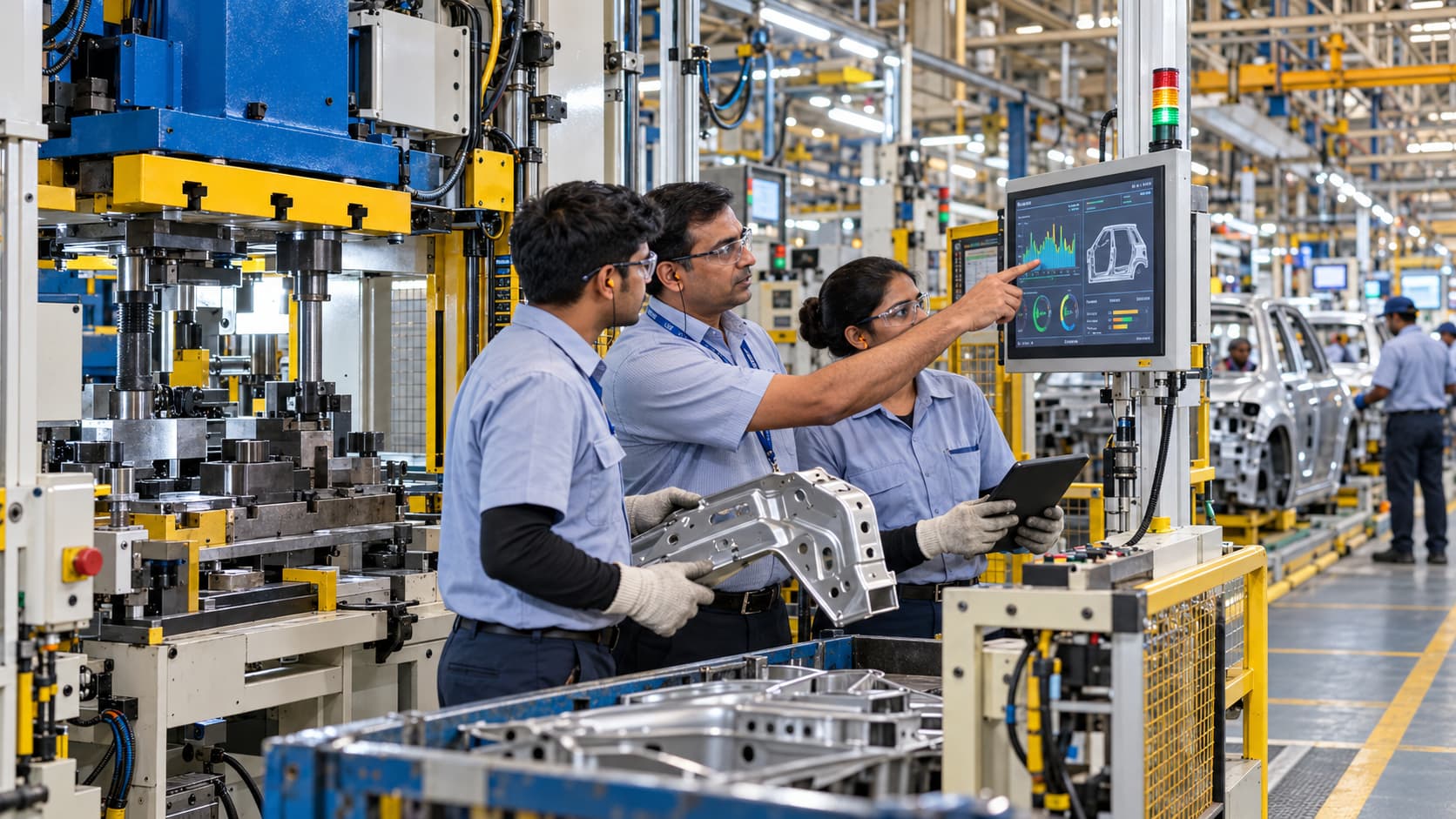
They may require specialised tooling, forming processes and quality controls.
Technologies such as hot stamping help manufacturers form certain high-strength steel components while achieving the required material properties.
Precision engineering is therefore becoming increasingly important as automotive designs become more complex.
-
The changing role of people in manufacturing
One common misconception about Industry 4.0 is that smart factories operate without people.
In reality, people continue to play an essential role.
Engineers design and improve manufacturing processes. Machine operators monitor equipment. Maintenance professionals investigate technical issues. Quality teams ensure that products meet required standards.
As digital technologies become more common, the skills required in manufacturing are also evolving.
Employees increasingly need to understand connected systems, data analysis, digital tools and automated equipment.
Training and continuous learning are therefore just as important as investing in new technology.
A smart factory is not simply a factory with advanced machines. It is a workplace where technology and people work together to improve outcomes.
What does the future of automotive manufacturing look like?
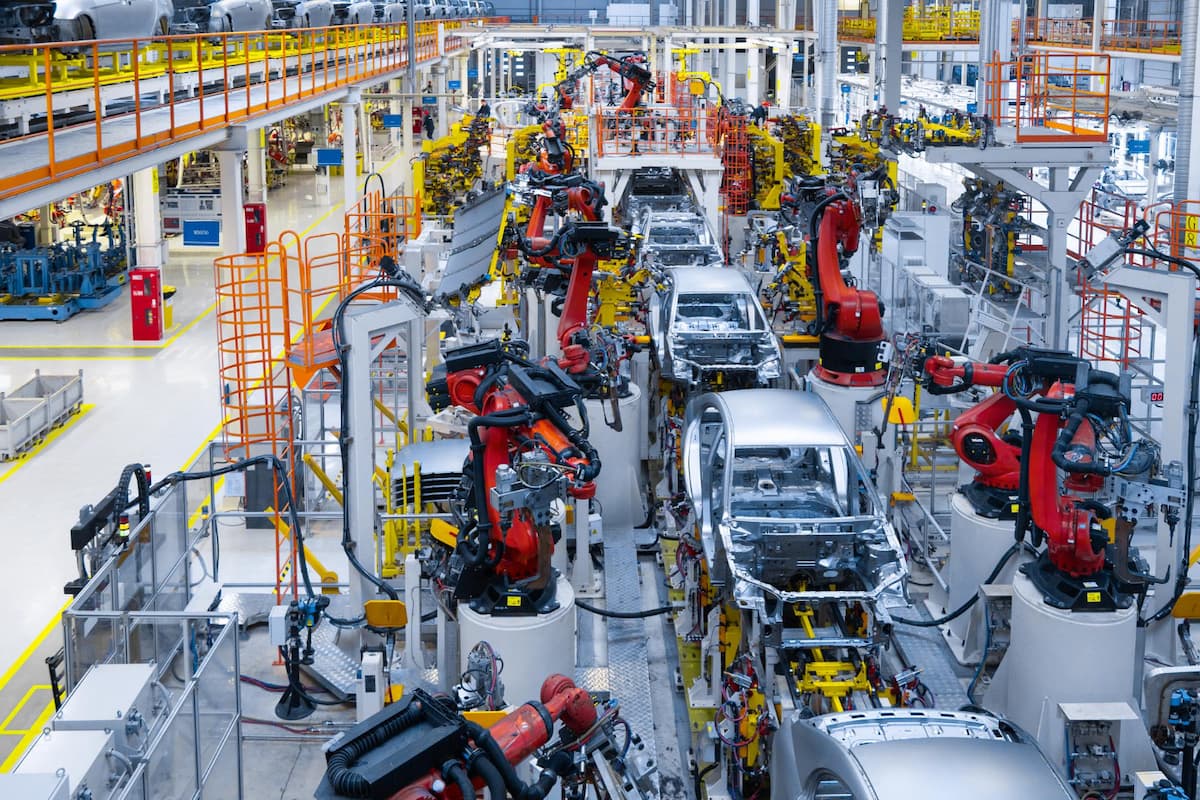
The next phase of automotive manufacturing will likely involve greater connectivity between design, production, quality and maintenance systems.
Manufacturers will have more opportunities to use data to improve processes, reduce waste and respond to changing customer requirements.
At the same time, the adoption of Industry 4.0 will vary across companies depending on their production requirements, investment capacity and digital readiness.
Not every manufacturing operation needs the same level of automation.
The important question is whether a technology solves a practical problem and creates measurable value.
Frequently Asked Questions (FAQs)
What is Industry 4.0 in simple terms?
Industry 4.0 means using connected machines, automation, sensors and digital technologies to make manufacturing processes more efficient, accurate and easier to monitor.
What is the difference between automation and Industry 4.0?
Automation allows machines to perform tasks with limited human involvement. Industry 4.0 goes further by connecting machines and systems so they can share information and support better operational decisions.
How is artificial intelligence used in automotive manufacturing?
AI can support quality inspection, predictive maintenance, production planning and data analysis. It helps manufacturers identify patterns and potential problems that may be difficult to detect through manual monitoring alone.
What is a digital twin in manufacturing?
A digital twin is a virtual representation of a physical machine, product or process that is connected to relevant real-world data. It can help manufacturers monitor performance, analyse operating conditions and test potential improvements.
Will Industry 4.0 replace human workers in factories?
Industry 4.0 can automate certain repetitive tasks and change the skills required for some jobs. However, people remain important for engineering, equipment management, problem-solving, quality assurance and decision-making. Training is essential as manufacturing roles evolve.